

BUILDING OF THE MONTH – GEDUNG PANCASILA – by Dr. C.J. van Dullemen
This time, our focus turns to a renowned edifice with a largely obscure history: The former Palace for the Army Commander in Batavia, presently known as the Gedung Pancasila.
The colonial architectural style of the early 19th century adheres to the prevailing design principles, resulting in an abundance of neoclassical structures throughout Indonesia. The edifice highlighted this month stands as an exceptional specimen: The former Palace for the Army Commander, now Gedung Pancasila, nestled within the Indonesian Foreign Affairs Ministry’s premises along Jl. Taman Pejambon.
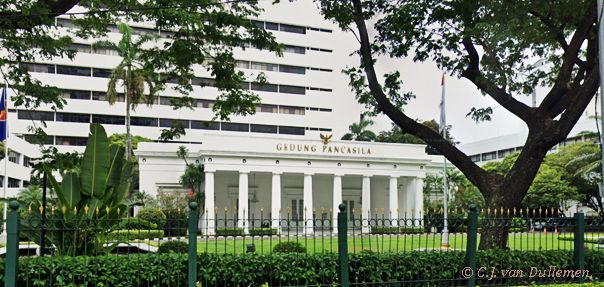
Since the dawn of architectural endeavours, columns have been favoured elements for government edifices, banks, churches, and temples. Columns confer dignity upon a structure, embodying power, strength, and solidity. Classical-style buildings, adorned with columns, grace the global landscape, ranging from the iconic Greek and Roman temples of antiquity to the White House in Washington, the Wall Street Stock Exchange in New York, the Madeleine Church in Paris, and the so-called Waterstaats churches in the Netherlands from the early 19th century, such as the Havenkerk in Schiedam.

In bygone eras, Jalan Taman Pejambon was named Hertogspark, paying homage to Duke Charles Bernard of Saksen-Weimar-Eisenach, a seasoned warrior who participated in the Battle of Waterloo and the 10-day campaign. Duke Charles ranks among the most decorated Dutch military figures, adorned with the Military Order of William, and commemorated with a dedicated monument on Lange Voorhout in The Hague. During his tenure as Commander of the Army in the Dutch East Indies (predecessor of the KNIL), he resided in the edifice of note from 1849 to 1851, dedicating a considerable portion of his time to the campaign against Bali.
While the architect behind the Palace for the Army Commander remains elusive, it is highly probable that the design emanated from the collaborative efforts of ten engineers under the purview of the chief engineer of Water Management and National Buildings in Batavia, Engineer Jannis Tromp. Tromp, born in IJzendijke in 1798, commenced his tenure with Water Management in the Dutch East Indies in 1816. In 1829, he ascended to the position of Chief Inspector of the Service of National Buildings, overseeing the entire design process of the Palace for the Army Commander and exerting influence therein. Unfortunately, drawings and descriptions from the nascent stages remain elusive. In 1889, the Palace for the Army Commander underwent redecoration, as chronicled by the Javabode: “the adornment of the regal residence is meticulously orchestrated and is poised to astound all in the Dutch East Indies with its refinement, opulence, and grandeur,” alongside observations that “the palace garden has been leased to a Chinese individual for vegetable cultivation” and “The general’s table must be well-supplied.”
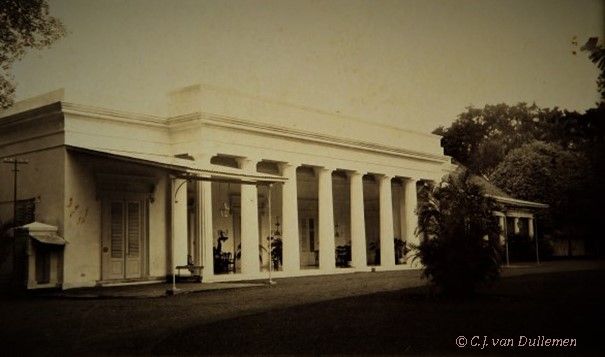
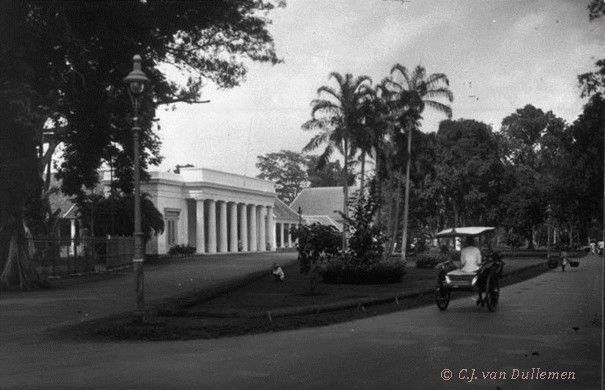
The Palace for the Army Commander features a commodious front gallery graced by eight Doric columns, epitomizing perfect symmetry with a grand entrance at its nucleus. Beyond this threshold lies an expansive hall spanning the edifice’s entire breadth, ideally suited for solemn ceremonies. It was this hall that rendered the building fitting for its subsequent role as the seat of the People’s Council, inaugurated in 1918, coinciding with the relocation of the army leadership’s headquarters to the new Palace for the Army Commander in Bandung. (Refer to my publication “Architect in Bandung”)
The Batavia Palace served as the venue for the People’s Council until February 27, 1942; its final assembly preceding the Japanese invasion. Despite its limited impact, the People’s Council contributed to the political consciousness of the Indonesian populace.
The zenith of this edifice’s significance undoubtedly transpired on June 1, 1945. On this historic day, Sukarno, the future inaugural president of Indonesia, delivered the oration that bestowed the structure with its present name. Entitled “Lahirnya Pancasila” (The Birth of Pancasila), this discourse laid the groundwork for the constitution of the Republic of Indonesia. Sukarno, then serving on the Committee for the Investigation of Indonesian Independence, encapsulated the essence of the Indonesian state within five foundational principles: National unity, deliberative democracy, social justice, civilized humanity, and belief in one Almighty God.
Annually, on June 1, Indonesia commemorates this pivotal event, perpetuating the significance of Pancasila.
@Dr. C.J. (Jan) van Dullemen.
—– ¥¥¥ —–
